Lost Cities, Ancient Tombs by National Geographic
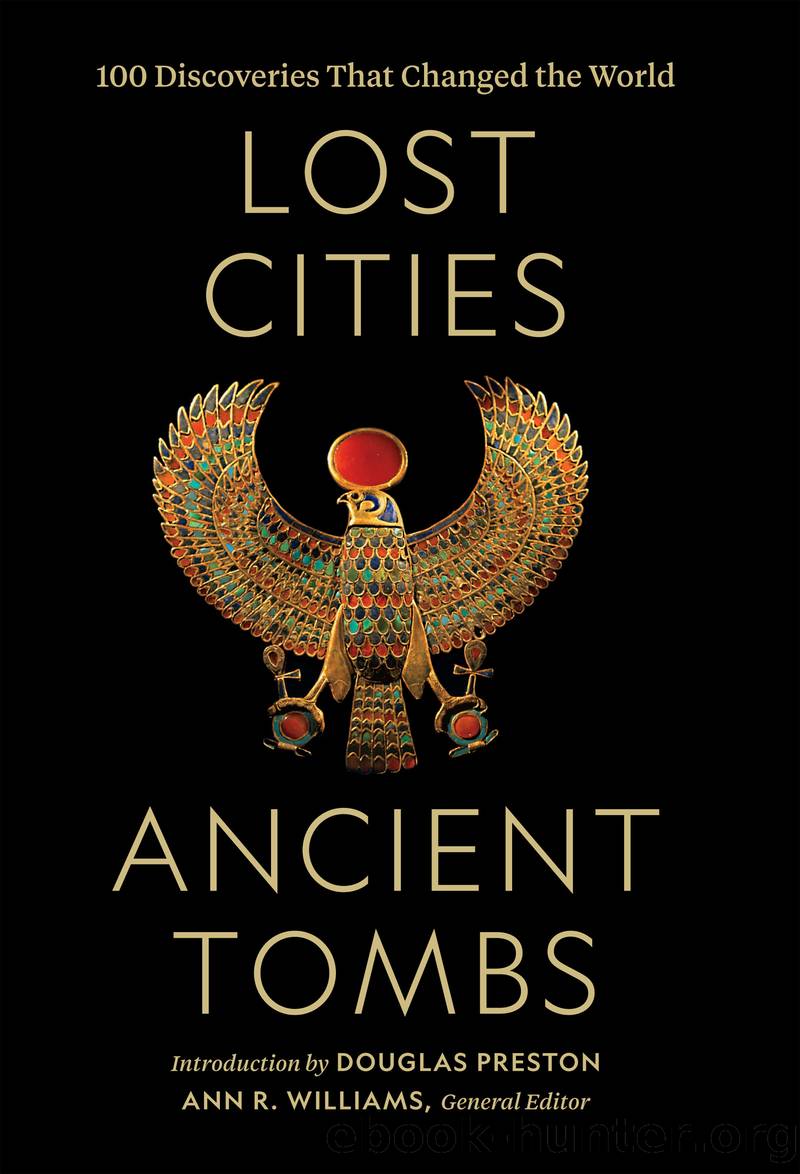
Author:National Geographic [Williams, `Doglas Preston and ANN R.]
Language: eng
Format: epub
Publisher: Disney Book Group
Published: 2021-11-15T00:00:00+00:00
In the summer of 1799, soldiers began a project to expand Fort de Saint-Julien in the town of El Rashid, also known as Rosetta, in the western delta. While digging up ancient walls to make way for new foundations, they found an intriguing stone with rough edges and a smooth, inscribed faceâobviously part of a broken monument that had been reused as a building block.
The officer in charge, Pierre-François Bouchard, thought it might be important and turned it over to the scientists who had accompanied Napoleon to Egypt. Fortunately, they made copies of the inscriptions, because the stone would soon leave their hands. By the end of 1801, Britain had brought Franceâs incursion into Egypt to an end and had taken possession of such antiquities as the Rosetta stone, as arranged by the Treaty of Alexandria.
Almost as soon as the stone was discovered, linguists had begun to puzzle out the secrets encoded in the three different writing systems displayed on it, which together offer a snapshot of the sweeping changes that transformed Egypt over many centuries. In a small, jagged triangle at the top are 14 precious lines of hieroglyphs, a complex script used from about 3200 B.C. to the late fourth century A.D. to record sacred texts on temples, tombs, coffins, monuments, and statues. The middle has 32 lines in Demotic, a cursive script from Egyptâs late pharaonic era that vastly simplified hieroglyphic writing for the purposes of administrative and commercial recordkeeping. The bottom section holds 53 lines in ancient Greek, the official language of the final Ptolemaic dynasty, with which 19th-century European scholars had some familiarity.
When the Rosetta stone was created in the second century B.C., all three of those languages were inscribed on it to ensure that everyone got the message. But with time, the ancient languages became unreadable. In the fourth century A.D., after the arrival of Christianity in Egypt, people stopped learning hieroglyphs because of the scriptâs link to a pagan religion. Egyptians then began to speak Coptic, written mostly with Greek letters but with a few Demotic signs thrown in to symbolize unique sounds. After the Arab invasion of the seventh century brought a new language and writing system, knowledge of the pharaohsâ texts died out completely.
The discovery of the Rosetta stone gave modern scholars the key to resurrect it. A translation of the Greek, completed quickly, revealed names such as Ptolemy and Alexander, which would prove crucial to deciphering the rest of the stone. French scholar Antoine Isaac Silvestre de Sacy and Swedish diplomat Johan David à kerblad began to work independently on the Demotic. Searching at first for the previously identified proper names, they then worked out a list of possible Demotic characters. They believed that Demotic used a phonetic alphabet, like Greek, whereas hieroglyphic writing used pictographic symbols. They were on the right track but not entirely correct.
In England, a physician, physicist, and mathematician named Thomas Young made breakthroughs when he realized that Demotic was a derivative hybrid, with âimitations of the hieroglyphs ⦠mixed with letters of the alphabet.
Download
This site does not store any files on its server. We only index and link to content provided by other sites. Please contact the content providers to delete copyright contents if any and email us, we'll remove relevant links or contents immediately.
Personalized inhaled bacteriophage therapy for treatment of multidrug-resistant Pseudomonas aeruginosa in cystic fibrosis by unknow(215771)
CONSORT 2025 statement: updated guideline for reporting randomized trials by unknow(102525)
Critical evaluation of the ProfiLER-02 study design and outcomes by Vivek Subbiah & Razelle Kurzrock(102054)
Cardiac gene therapy makes a comeback by Oliver J. Müller & Susanne Hille & Anca Kliesow Remes(101842)
Whisky: Malt Whiskies of Scotland (Collins Little Books) by dominic roskrow(74631)
Unveiling the design rules for tunable emission in graphene quantum dots: A high-throughput TDDFT and machine learning perspective by Şener Özönder & Mustafa Coşkun Özdemir & Caner Ünlü(51004)
A yeast-based oral therapeutic delivers immune checkpoint inhibitors to reduce intestinal tumor burden by unknow(40377)
Covalent hitchhikers guide proteins to the nucleus by Alexander F. Russell & Madeline F. Currie & Champak Chatterjee(40299)
Meet the Authors: Christopher R. Mansfield and Emily R. Derbyshire by Christopher R. Mansfield & Emily R. Derbyshire(40213)
Alkaline-earth metals promote propane dehydrogenation with carbon dioxide through geometric effects: Altering the reaction pathway by unknow(32817)
Induced iron vacancies boosting FeOOH loaded on sustainable Fenton-like collagen fiber membrane for efficient removal of emerging contaminants by unknow(32615)
Efficient electric-field-assisted photochemical conversion of methane to n-propanol exclusively over penetrated TiO2Ti hollow fibers by Guanghui Feng(32533)
Bi2SiO5 nanosheets as piezo-photocatalyst for efficient degradation of 2,4-Dichlorophenol by Hangyu Shi & Yifu Li & Lishan Zhang & Guoguan Liu & Qian Zhang & Xuan Ru & Shan Zhong(32471)
A novel NDIPTA organic heterojunction photocatalyst with built-in electric field for efficient hydrogen production by Jiahui Yang & Baojun Ma & Yongfa Zhu(32445)
Enhanced conversion of methane to liquid-phase oxygenates via hollow ferrite nanotube@horseradish peroxidase based photoenzymatic catalysis by Jun Duan & Shiying Fan & Xinyong Li & Shaomin Liu(32407)
Ordered macroporous superstructure of defective carbon adorned with tiny cobalt sulfide for selective electrocatalytic hydrogenation of cinnamaldehyde by Xiao-Shi Yuan & Sheng-Hua Zhou & San-Mei Wang & Wenbo Wei & Xiaofang Li & Xin-Tao Wu & Qi-Long Zhu(32337)
What's Done in Darkness by Kayla Perrin(27264)
Topological analysis of non-conjugated ethylene oxide cored dendrimers decorated with tetraphenylethylene: Insights from degree-based descriptors using the polynomial approach by A Theertha Nair & D Antony Xavier & Annmaria Baby & S Akhila(26637)
Investigation of mechanical and self-healing properties of hydroxyl-terminated polybutadiene functionalized with 2-ureido-4-pyrimidinone by Mohsen Kazazi & Mehran Hayaty & Ali Mousaviazar(26557)
